The conventional approach
For decades, the seismic industry has relied on a linear, four-stage workflow: preprocessing, model building, imaging (migration), and quantitative interpretation, of which the latter includes amplitude-versus-angle (AVA) inversion to derive elastic rock properties. While tried and tested, this sequence is tethered to assumptions, most notably the acoustic and single-scattering (Born) approximations. These assumptions require aggressive preprocessing to strip away “noise” such as ghosts and multiples, components of the recorded wavefield that contain additional information about the subsurface.
By discarding these multiscattering arrivals, conventional imaging (like Kirchhoff or RTM) limits illumination to primary-only reflections. This often leads to poor resolution in geologically complex areas, such as pre-salt environments or shallow water settings with strong impedance contrasts. Furthermore, the traditional workflow introduces subjectivity at every stage, where, for example, errors in the velocity model or processing of the seismic data amplitudes can severely compromise the fidelity of the final AVA attributes.
Viscoelastic Multi-parameter FWI
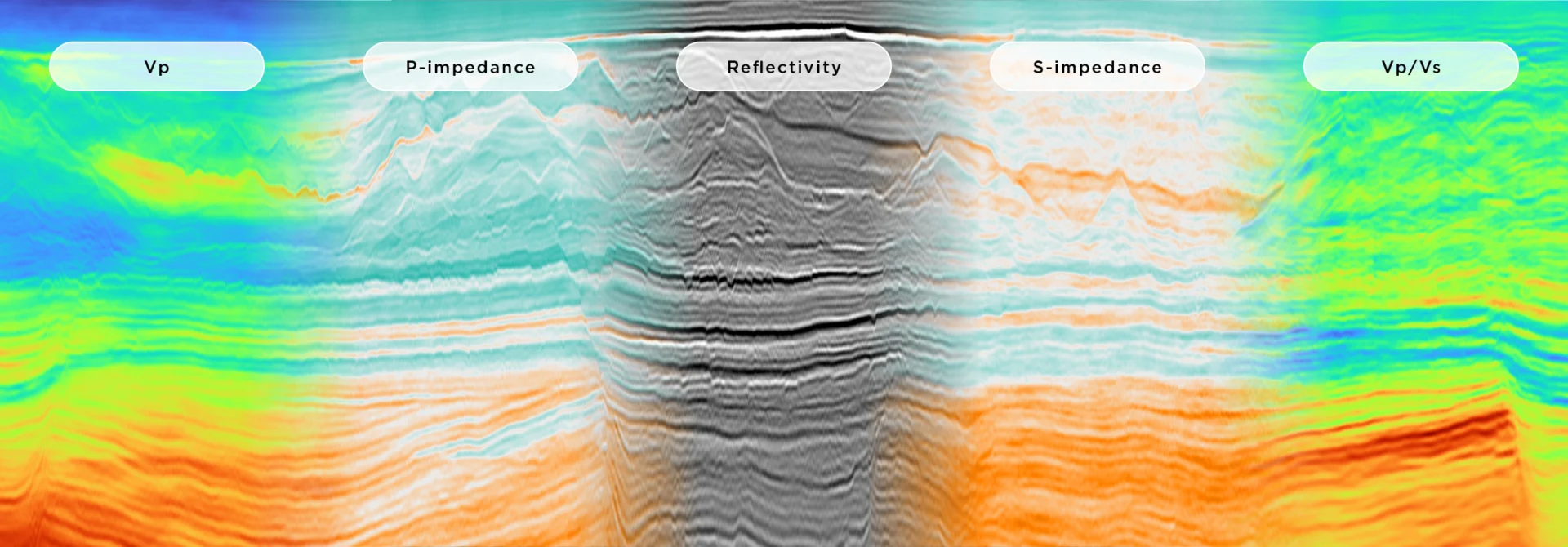
Viscoelastic multi-parameter full-waveform inversion (MP-FWI) represents a seismic shift by collapsing the conventional workflow into a streamlined, high-fidelity process. Instead of treating seismic imaging as the result of a sequence of independent steps, MP-FWI directly inverts for subsurface properties (such as Vp, Vs/Vp ratio, and P-impedance) from raw or minimally processed field data.
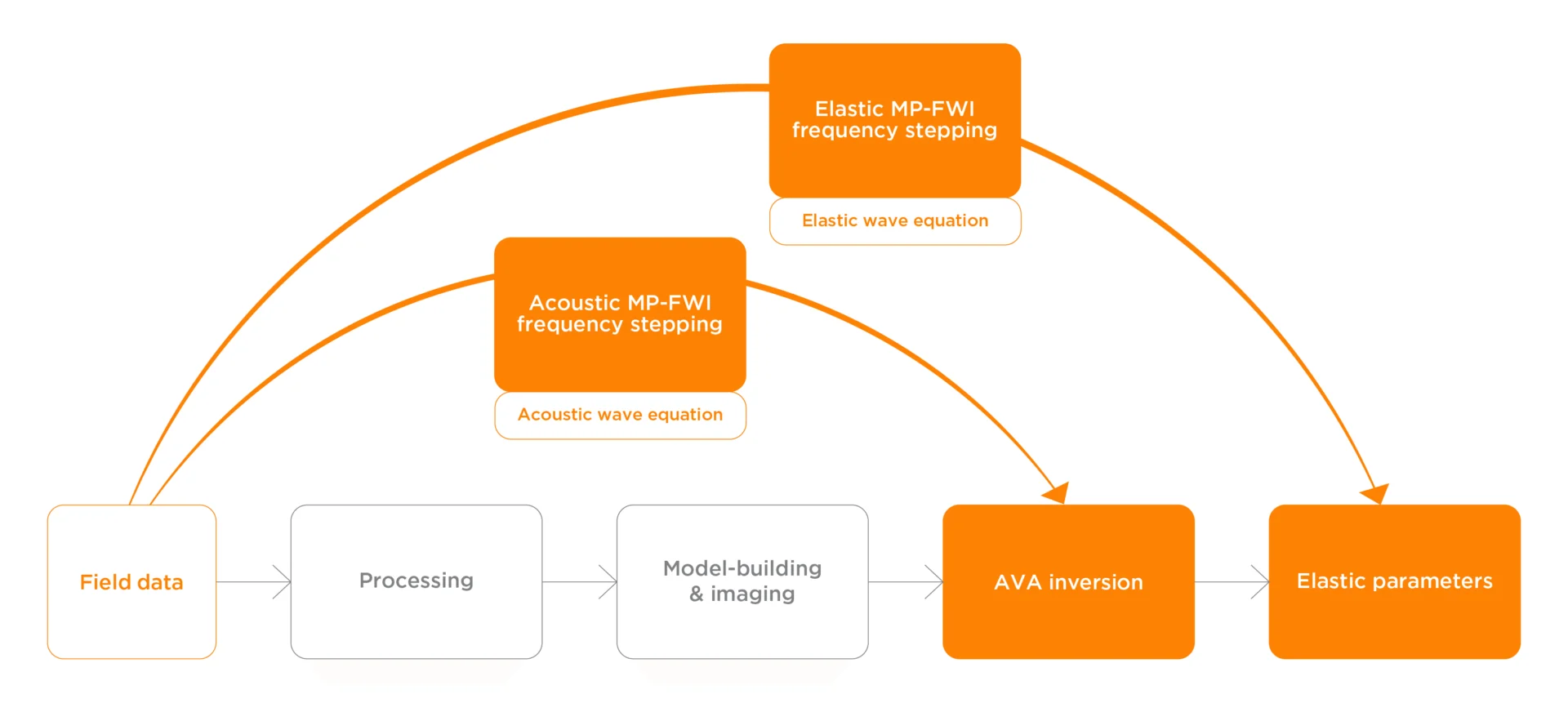
The beauty of this approach lies in its use of the full wavefield. By incorporating the physics of viscoelastic wave propagation, MP-FWI transforms formerly discarded “noise” (multiples, ghosts, and transmission arrivals) into valuable signal that improves both resolution and illumination. This method eliminates the need for a distinct, external AVA-inversion step, as elastic attributes are resolved simultaneously within the inversion. By leveraging a modified L-BFGS optimizer, the workflow mitigates parameter crosstalk, ensuring that density and velocity updates remain geologically consistent without enforcing rigid, often unreliable empirical relations.
Real-World Proof: Case Studies
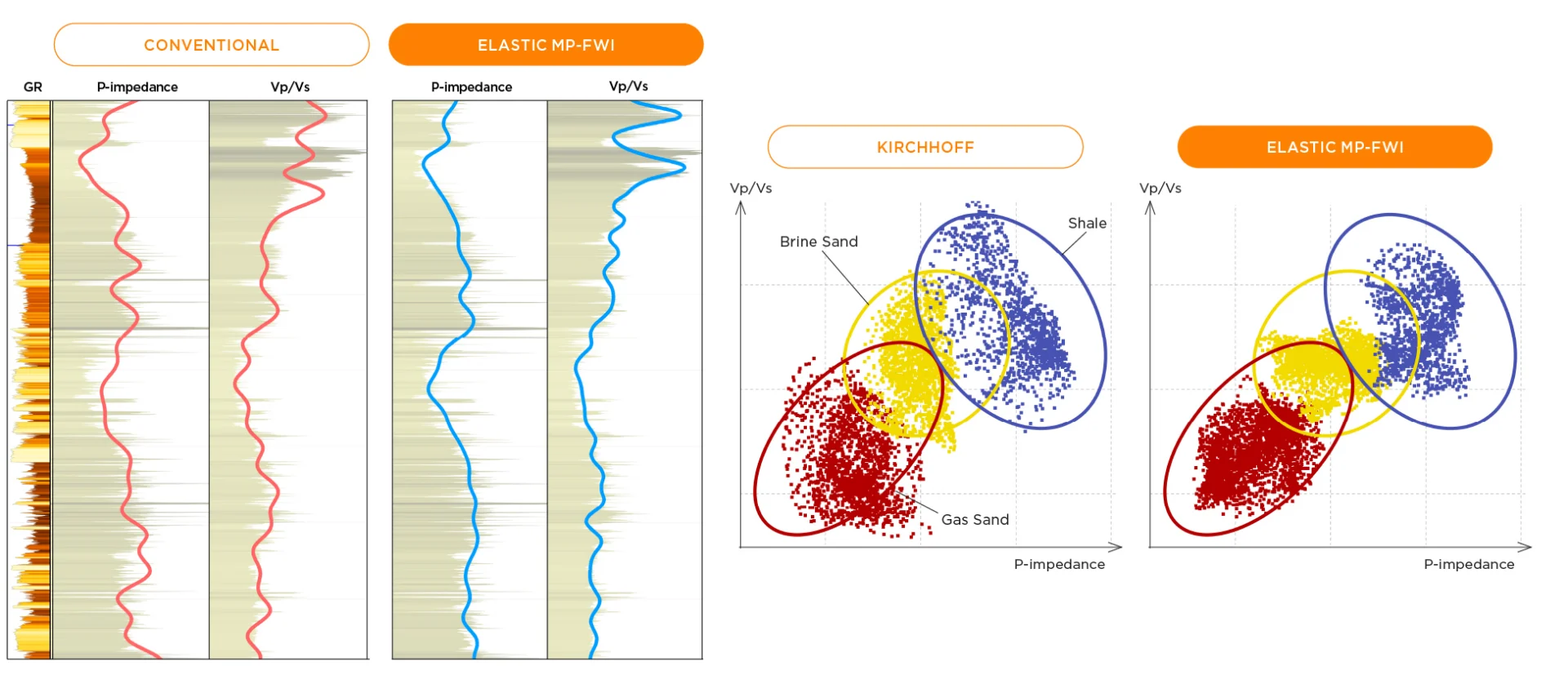
The success of this approach has been demonstrated across numerous case studies. McLeman et al. (2026) demonstrated that using legacy towed-streamer data, the MP-FWI workflow successfully identified gas reservoirs in the Triassic Mungaroo Formation on the Australian North West Shelf. The inversion delivered a significant increase in spatial resolution, clearly delineating thin layers and accurately predicting the decrease in P-impedance and Vp, and increase in Vs/Vp ratio associated with gas saturation. The results showed a superior match to well-log data and statistical rock physics models compared to conventional Kirchhoff-based AVA inversion. Applying the same method to a sparse Ocean-Bottom Node (OBN) data set from the Gulf of America showed how multiscattered energy assisted in overcoming complex salt-related illumination issues. The viscoelastic MP-FWI reflectivity outperformed traditional RTM, providing sharper structural focusing and improved imaging of pre-salt targets.
Kobylarski et al. (2026) applied the technique up to 45 Hz using a deep-water ocean-bottom node (OBN) seismic survey acquired in 2024 offshore West Africa. The results demonstrated enhanced subsurface illumination by combining OBN data with viscoelastic MP-FWI. This provided significantly improved resolution and structural detail compared to legacy narrow-azimuth towed-streamer imaging. The derived models accurately isolated the main gas cloud complex and captured critical reservoir features, such as faults and a clear flat-spot reflection indicating a hydrocarbon-water contact. The inverted models showed geologically consistent parameter updates, such as decreased P-impedance in the reservoir and increased Vs/Vp within the gas cloud, and demonstrated a strong match with existing well logs.
A New Foundation for Quantitative Interpretation
By replicating the seismic acquisition in a supercomputer with more complete physics, viscoelastic MP-FWI reduces the subjectivity introduced by data preprocessing and overcomes the limitations of primary-only imaging. The approach has also ushered in a new foundation for the seismic-based inputs of QI, and importantly, it moves QI expertise to the onset of the seismic workflow. This means a simpler and less subjective route to reservoir characterization while preserving the central role of QI expertise.
For more information, visit: https://dug.com/geoscience-services/full-waveform-inversion-fwi/
References
Kobylarski, M., Chaloner, J., Kraus, K., Chowdhury, B., Micu, M and Rayment, T., 2026, Triple-Parameter Viscoelastic MP-FWI from Offshore West Africa: EAGE Annual Conference & Exhibition, Volume 2026, p. 1 – 5.
McLeman, J., Badry, J., Rayment, T., and Pauli, A., 2026, Unlocking rock properties using viscoelastic multiparameter FWI: The Leading Edge; 45 (5): 370–377. doi: https://doi.org/10.1190/tle-2025-1055.